Blog

Home >> Blog >> Zahnarztsuche nach Ordinationsschluss: Warum Online-Buchung und KI-Assistent gemeinsam entscheidend sind
Blog Auswahl       Für Patienten   Oder    Für Zahnärzte

E-Mail hier eingeben und Abo starten:


Zahnarztsuche nach Ordinationsschluss: Warum Online-Buchung und KI-Assistent gemeinsam entscheidend sind

Hinzugefügt am 15.09.2026

KI Assistent in der Zahnarztpraxis

Patientinnen und Patienten beschäftigen sich nicht nur während der Ordinationszeiten mit der Suche nach einer Zahnarztpraxis. Häufig entsteht der Wunsch nach einem Termin am Abend, am Wochenende oder genau dann, wenn das Praxistelefon nicht besetzt ist.

Eine gut sichtbare Online-Terminbuchung ermöglicht es Patienten, auch außerhalb der Öffnungszeiten einen verfügbaren Termin auszuwählen. Doch nicht jeder Patient kann oder möchte seinen Termin ohne vorherige Rückfrage selbst buchen.

Weiterlesen

Mehrsprachige Patientenbetreuung: Wie KI Zahnarztpraxen am Telefon entlasten kann

Hinzugefügt am 08.09.2026

KI in der Zahnarztsuche
Sprachbarrieren am Telefon kosten Zahnarztpraxen Zeit und erschweren Patientinnen und Patienten die Kontaktaufnahme. Eine mehrsprachige KI-Telefonassistenz kann wiederkehrende Anfragen bearbeiten und das Praxisteam im Alltag entlasten.
Weiterlesen

Wird Ihre Zahnarztpraxis von ChatGPT gefunden? Warum strukturierte Praxisprofile für die KI-Sichtbarkeit entscheidend werden

Hinzugefügt am 27.08.2026
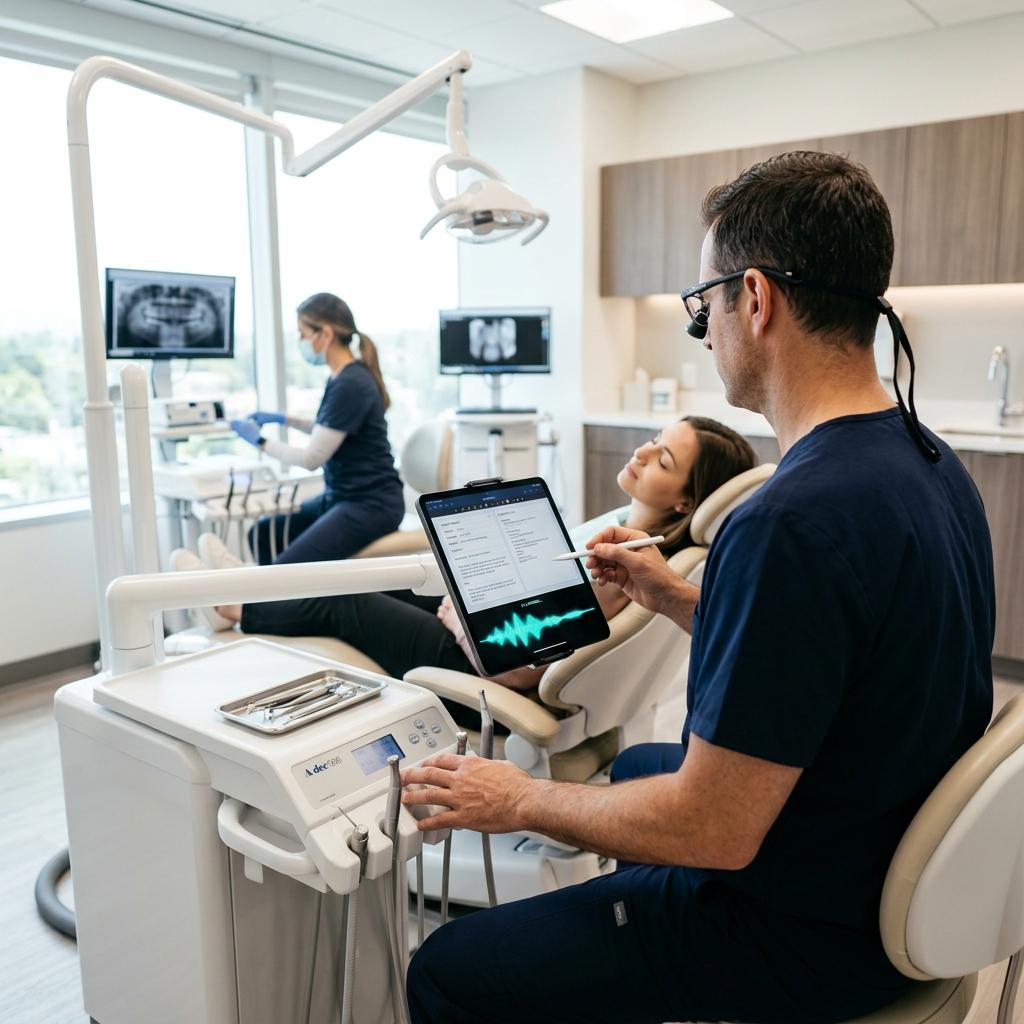
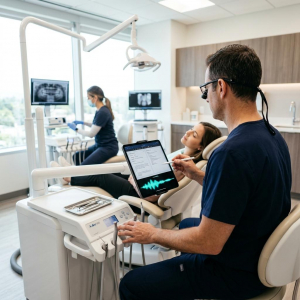
Zahnärzte: Patientengespräche mit dem KI Note-Taker automatisch dokumentieren
Patienten suchen Zahnärzte längst nicht mehr ausschließlich über klassische Google-Ergebnisse. Sie stellen zunehmend vollständige Fragen an ChatGPT und andere KI-gestützte Suchsysteme.
Weiterlesen

KI-Dokumentation in der Zahnarztpraxis: Wie viel Zeit lässt sich sparen?

Hinzugefügt am 17.08.2026

<article>    <h1>AI Documentation in Dental Practices: How Much Time Can Be Saved?</h1>    <p>     Documenting patient conversations, completing notes, structuring information,     and processing treatment records are all part of the daily routine in a dental practice.   </p>    <p>     Even a few minutes of documentation time per patient can add up to many working hours over the course of a month.   </p>    <p>     <strong>In short:</strong> If a dental practice saves only     3 minutes of documentation time per patient with the help of AI,     this can amount to <strong>10 hours saved per month</strong>     with 10 patients per day and 20 working days.   </p>    <p>     The actual time savings depend on the number of patients, type of treatment,     documentation requirements, practice workflows, and the AI solution being used.   </p>    <p>     The key question is therefore:   </p>    <p>     <strong>       How much time does your practice currently spend on documentation,       and how much of that time could potentially be reduced with AI support?     </strong>   </p>     <h2>How Much Time Does Documentation Take in a Dental Practice?</h2>    <p>     Even a few minutes per patient can quickly add up.   </p>    <p>     As a <strong>calculation example</strong>, let us assume that a dental practice     sees 10 patients per day and spends 7 minutes per patient on conversation documentation     and related follow-up work.   </p>    <p>     <strong>10 patients × 7 minutes = 70 minutes per working day</strong>   </p>    <p>     Over 20 working days per month:   </p>    <p>     <strong>70 minutes × 20 days = 1,400 minutes</strong>   </p>    <p>     That equals:   </p>    <p>     <strong>23 hours and 20 minutes of documentation time per month.</strong>   </p>    <p>     Important: The 7 minutes used here are a     <strong>sample assumption for illustration purposes</strong>     and not a general industry average. Actual documentation time may be significantly     higher or lower depending on the practice, treatment, and individual workflow.   </p>     <h2>Why Is Documentation Time Also Economically Relevant?</h2>    <p>     The important question is not only how many hours are spent on documentation.   </p>    <p>     It is also important to consider     <strong>how that time could otherwise be used</strong>.   </p>    <ul>     <li>more time for patient consultations,</li>     <li>more detailed treatment discussions,</li>     <li>additional treatments,</li>     <li>less administrative work between appointments,</li>     <li>less follow-up work at the end of the day.</li>   </ul>    <p>     Reducing documentation time does not automatically translate into additional revenue.   </p>    <p>     However, it can create additional capacity that may be used for more patients,     treatments, or improved practice organization, depending on the practice's workload     and operational structure.   </p>     <h2>How Can a Dental Practice Calculate Its Documentation Workload?</h2>    <p>     A simple formula can provide an initial estimate:   </p>    <p>     <strong>       Patients per day × documentation minutes per patient × working days per month     </strong>   </p>    <p>     Example:   </p>    <p>     <strong>10 × 7 × 20 = 1,400 minutes</strong>   </p>    <p>     That equals:   </p>    <p>     <strong>23 hours and 20 minutes per month.</strong>   </p>    <p>     If documentation takes only 5 minutes per patient with the same patient volume:   </p>    <p>     <strong>10 × 5 × 20 = 1,000 minutes = 16 hours and 40 minutes per month.</strong>   </p>    <p>     This simple calculation allows each practice to estimate how much working time     is currently spent on documentation.   </p>     <h2>How Much Time Can AI Documentation Save in a Dental Practice?</h2>    <p>     There is no universal answer to how much time AI can save.   </p>    <p>     The potential time savings depend on factors such as patient volume,     documentation requirements, practice workflows, and which tasks can be supported by AI.   </p>    <p>     Even small savings per patient can add up significantly.   </p>    <p>     For example, if a practice sees 10 patients per day and saves only     3 minutes of documentation time per patient over 20 working days:   </p>    <p>     <strong>10 patients × 3 minutes × 20 days = 600 minutes</strong>   </p>    <p>     That equals:   </p>    <p>     <strong>10 hours of potential time savings per month.</strong>   </p>    <p>     If 5 minutes are saved per patient under the same assumptions:   </p>    <p>     <strong>16 hours and 40 minutes per month.</strong>   </p>    <p>     These figures are calculation examples and not guaranteed savings.     The actual potential depends on the individual workflow of each dental practice.   </p>     <h2>What Is AI Documentation in a Dental Practice?</h2>    <p>     AI documentation is designed to support dentists with recurring tasks     related to documenting patient conversations.   </p>    <p>     Instead of manually summarizing an entire conversation after an appointment,     AI can help structure and prepare relevant information for further documentation.   </p>    <p>     The aim is not to replace the dentist.   </p>    <p>     <strong>       AI supports administrative tasks, while professional review,       clinical assessment, and medical decisions remain with the treating dentist.     </strong>   </p>     <h2>How Does an AI Note-Taker for Dentists Work?</h2>    <p>     An AI note-taker supports the capture and structured processing     of relevant information from patient conversations.   </p>    <p>     While the dentist focuses on the patient and the conversation,     the technology assists in creating structured documentation of the discussion.   </p>    <p>     This can reduce the manual effort required for notes and follow-up documentation.   </p>    <p>     However, the generated content should still be professionally reviewed     and processed according to the requirements of the dental practice.   </p>     <h2>What Benefits Can AI Documentation Offer Dentists?</h2>    <p>     The most important potential benefit is not the AI itself,     but the <strong>time that may be saved</strong>.   </p>    <ul>     <li>fewer manual conversation notes,</li>     <li>less follow-up work after appointments,</li>     <li>more structured documentation,</li>     <li>greater attention during patient conversations,</li>     <li>more available time for patients,</li>     <li>reduced administrative workload.</li>   </ul>    <p>     Whether and to what extent these benefits can be achieved     must be evaluated individually for each dental practice.   </p>     <h2>DentalAce AI Note-Taker: Support for Documenting Patient Conversations</h2>    <p>     The <strong>DentalAce AI Note-Taker</strong> was developed to support dentists     in documenting patient conversations.   </p>    <p>     While the dentist focuses on the conversation with the patient,     the AI supports the structured capture and preparation of relevant information.   </p>    <p>     The solution is particularly aimed at dental practices that want to reduce     the amount of time spent on conversation notes and follow-up documentation.   </p>    <p>     <strong>Less documentation. More time for patients.</strong>   </p>     <h2>When Is an AI Note-Taker Worthwhile for a Dental Practice?</h2>    <p>     Not every dental practice has the same workflow.     Before introducing an AI solution, the current documentation workload should be assessed.   </p>    <ul>     <li>How many patients do we treat each day?</li>     <li>How many minutes do we currently spend documenting each patient conversation?</li>     <li>Which tasks are repeated regularly?</li>     <li>Which of these tasks could reasonably be supported by AI?</li>     <li>How much time could potentially be saved per patient?</li>   </ul>    <p>     Only by looking at these factors can a practice estimate the true potential     of AI-assisted documentation.   </p>     <h2>AI Should Save Time – Not Create Additional Work</h2>    <p>     The benefit of an AI solution does not come from using as many digital functions as possible.   </p>    <p>     The more important question is:   </p>    <p>     <strong>Does the technology actually save time in daily practice?</strong>   </p>    <p>     AI should therefore not be evaluated in isolation.     The key question is how well it fits into existing workflows     and whether it genuinely simplifies repetitive tasks.   </p>    <p>     The practical benefit should be measurable.   </p>     <h2>Conclusion: What Matters Is the Actual Time Saved</h2>    <p>     AI can be particularly useful for dental practices when it solves     a clearly defined and recurring problem.   </p>    <p>     With documentation, the potential benefit can be assessed relatively easily:   </p>    <p>     <strong>       How many minutes do I spend on documentation today,       and how many minutes would I need with AI support?     </strong>   </p>    <p>     Even a few minutes saved per patient can add up to several working hours over a month.   </p>    <p>     The key question is therefore not:   </p>    <p>     <strong>“Does my dental practice need AI?”</strong>   </p>    <p>     But rather:   </p>    <p>     <strong>       “Which recurring tasks can AI meaningfully support       so that more time remains for patients?”     </strong>   </p>     <h2>Discover the DentalAce AI Note-Taker</h2>    <p>     Would you like to see how the <strong>DentalAce AI Note-Taker</strong>     can be used in everyday dental practice?   </p>    <p>     We can show you the solution in a     <strong>personal and non-binding presentation</strong>     and discuss where AI could support documentation     and potentially save time in your practice.   </p>    <p>     <strong>       Interested? Contact DentalAce for a personal presentation       of the AI Note-Taker.     </strong>   </p>     <section id="faq">      <h2>Frequently Asked Questions About AI Documentation in Dental Practices</h2>      <h3>What is an AI note-taker for dentists?</h3>      <p>       An AI note-taker supports the capture and structured processing       of relevant information from patient conversations.       This can reduce the manual effort required for conversation notes       and follow-up documentation.     </p>       <h3>How much time can an AI note-taker save?</h3>      <p>       There is no universal time-saving figure.       The potential depends on patient volume, type of treatment,       documentation requirements, existing workflows,       and the technology being used.       Even a few minutes saved per patient can, however,       add up to several hours over the course of a month.     </p>       <h3>Does an AI note-taker replace documentation by the dentist?</h3>      <p>       No. An AI note-taker is designed to support the capture       and structuring of information.       Professional review, clinical assessment,       and responsibility remain with the treating dentist.     </p>       <h3>Which dental practices can benefit from an AI note-taker?</h3>      <p>       The technology may be particularly relevant for practices       in which patient conversations are documented regularly       and a significant amount of time is spent on notes       and follow-up documentation.     </p>       <h3>How can a dental practice calculate its potential time savings?</h3>      <p>       A simple formula provides an initial estimate:       <strong>patients per day × minutes saved per patient × working days per month.</strong>       For example, saving three minutes per patient with 10 patients per day       over 20 working days results in 600 minutes,       or 10 hours, per month.     </p>       <h3>Is an AI note-taker compliant with data protection requirements?</h3>      <p>       Data protection and data security are especially important       when information from patient conversations is processed.       Whether and under which conditions a particular solution can be used       in compliance with applicable data protection requirements depends       on its technical implementation, the data processed,       the service providers involved, and how the solution is used in practice.     </p>      <p>       Dental practices should therefore review how patient data is processed,       transmitted, and stored, and which legal and data protection requirements       apply to the specific use case.     </p>       <h3>How does the DentalAce AI Note-Taker work in a dental practice?</h3>      <p>       The DentalAce AI Note-Taker supports the structured capture       and preparation of relevant information from patient conversations.       Its purpose is to reduce the manual workload associated with conversation notes       and follow-up documentation while professional review remains       with the treating dentist.     </p>    </section>     <section>      <h2>About DentalAce</h2>      <p>       <strong>DentalAce</strong> develops digital solutions for dental practices       and combines digital visibility, online appointment booking,       verified patient reviews, and AI-powered solutions for everyday practice.     </p>      <p>       DentalAce focuses in particular on how digital technologies       can support dentists with patient communication,       practice organization, and recurring administrative tasks.     </p>      <p>       <strong>Author: Emil Nedev – Founder of DentalAce</strong>     </p>      <p>       <em>DentalAce – Digital Solutions for Dental Practices</em>     </p>    </section>  </article>   passende bilder generieren ohne viel text  Generiertes Bild: Digitale Zahnmedizin im modernen Praxisalltag  heute 22:54 Bearbeitetes Bild 1245 x 1245  Generiertes Bild: Zahnarzt am Laptop in moderner Praxis Mit der OpenAI API loslegen Generiere Bilder in deiner App mit OpenAI-Bildmodellen.   Zahnarzt am Laptop in moderner Praxis
Patientengespräche dokumentieren, Notizen ergänzen, Informationen strukturieren und Behandlungsunterlagen nachbearbeiten: Dokumentation gehört zum Alltag jeder Zahnarztpraxis.

Dabei können bereits wenige Minuten Dokumentationsaufwand pro Patient über einen Monat hinweg viele Arbeitsstunden ausmachen.

Weiterlesen

Warum Patienten Ihre Zahnarztpraxis ansehen – und trotzdem keinen Termin buchen

Hinzugefügt am 11.08.2026

Zahnarztpraxis und Terminbuchnung

Patienten suchen heute häufig online nach einer Zahnarztpraxis, vergleichen Leistungen, lesen Bewertungen und prüfen Kontakt- und Terminmöglichkeiten. Doch digitale Sichtbarkeit allein führt nicht automatisch zu einem neuen Patienten.
Weiterlesen

DentalAce Reputation Report 2026: Wie viele verifizierte Patientenbewertungen braucht eine Zahnarztpraxis wirklich?

Hinzugefügt am 31.07.2026
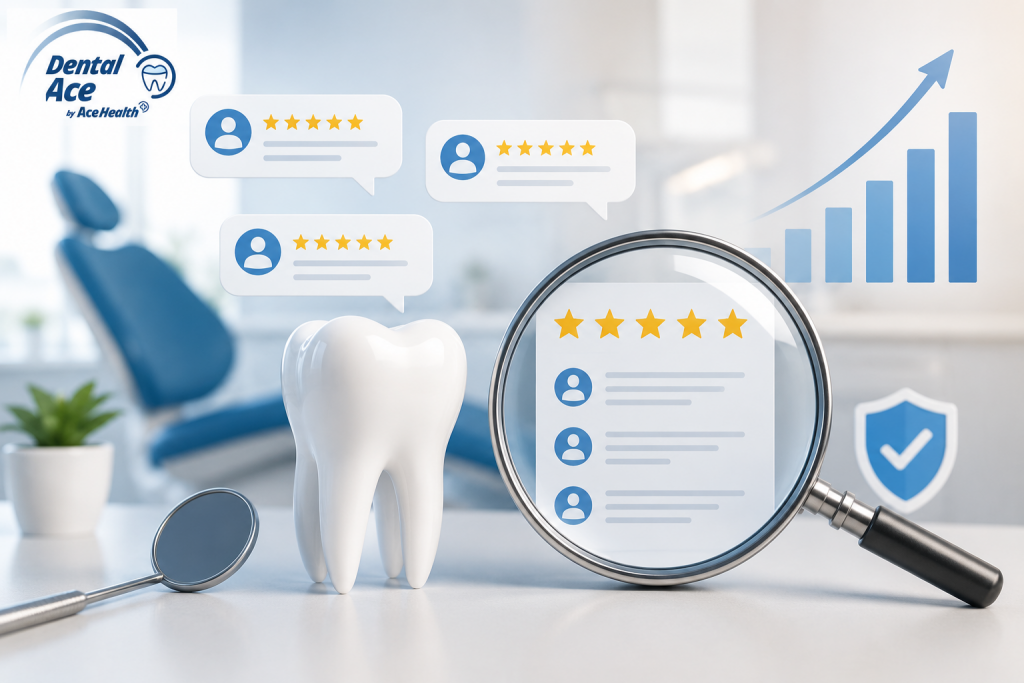
Zahnarztpraxis und Bewertungen

Vertrauen ist eine der wichtigsten Voraussetzungen im Gesundheitswesen. Noch bevor Patienten eine Zahnarztpraxis kontaktieren, informieren sie sich häufig online über Bewertungen, Behandlungsschwerpunkte, Terminmöglichkeiten und den Gesamteindruck einer Praxis.
Weiterlesen

Praxisoptimierung 2026: Wie Künstliche Intelligenz Zahnärzten mehr Zeit für ihre Patienten verschaffen

Hinzugefügt am 27.07.2026

Zahnarztpraxis - Zahnärztin & Patientin
Der Alltag in einer Zahnarztpraxis wird zunehmend komplexer. Neben der eigentlichen Behandlung nehmen Dokumentation, Befunderfassung, Patientenaufklärung und organisatorische Aufgaben einen erheblichen Teil der Arbeitszeit in Anspruch.

Moderne KI-Systeme eröffnen hier neue Möglichkeiten. Sie unterstützen Zahnärzte dabei, wiederkehrende Verwaltungsaufgaben zu automatisieren und dadurch mehr Zeit für das Wesentliche zu gewinnen: die persönliche Betreuung ihrer Patienten.

Weiterlesen

Neue Marktanalyse 2026: Wie KI und digitale Sichtbarkeit die Patientengewinnung von Zahnarztpraxen verändern

Hinzugefügt am 23.07.2026
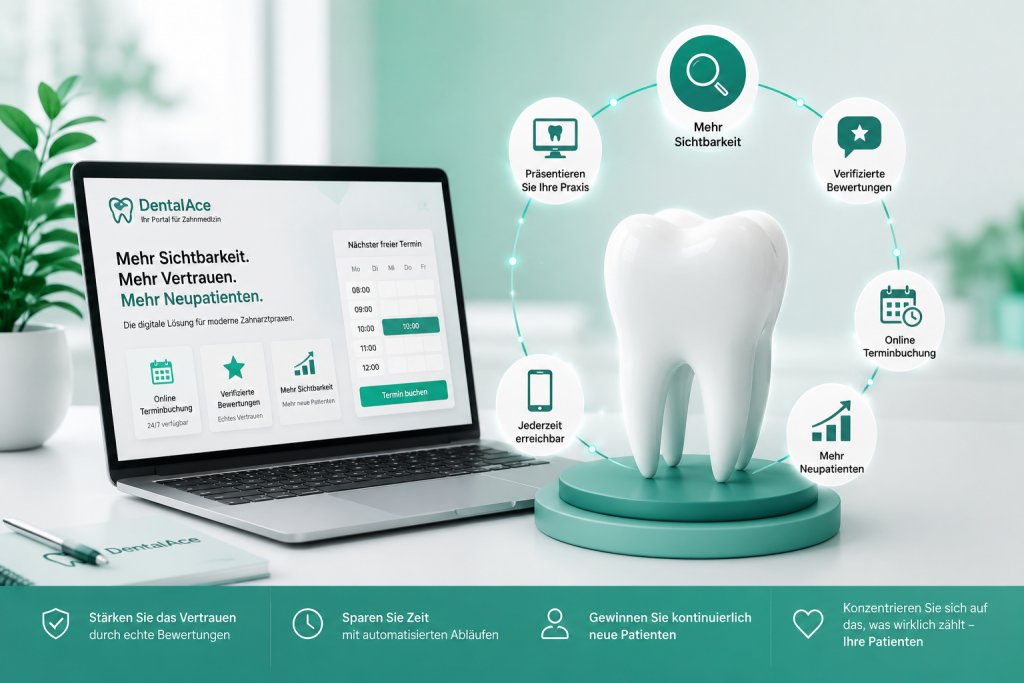
Notebook - DentalAce
Noch vor wenigen Jahren entschieden vor allem der Praxisstandort und persönliche Empfehlungen darüber, welche Zahnarztpraxis neue Patienten gewann.

Heute hat sich dieses Verhalten grundlegend verändert. Immer mehr Menschen informieren sich zuerst online, vergleichen Bewertungen, Leistungen und Terminmöglichkeiten und treffen ihre Entscheidung häufig schon vor dem ersten persönlichen Kontakt.

Weiterlesen

Wie Google heute entscheidet, welche Zahnarztpraxis sichtbar wird

Hinzugefügt am 20.07.2026
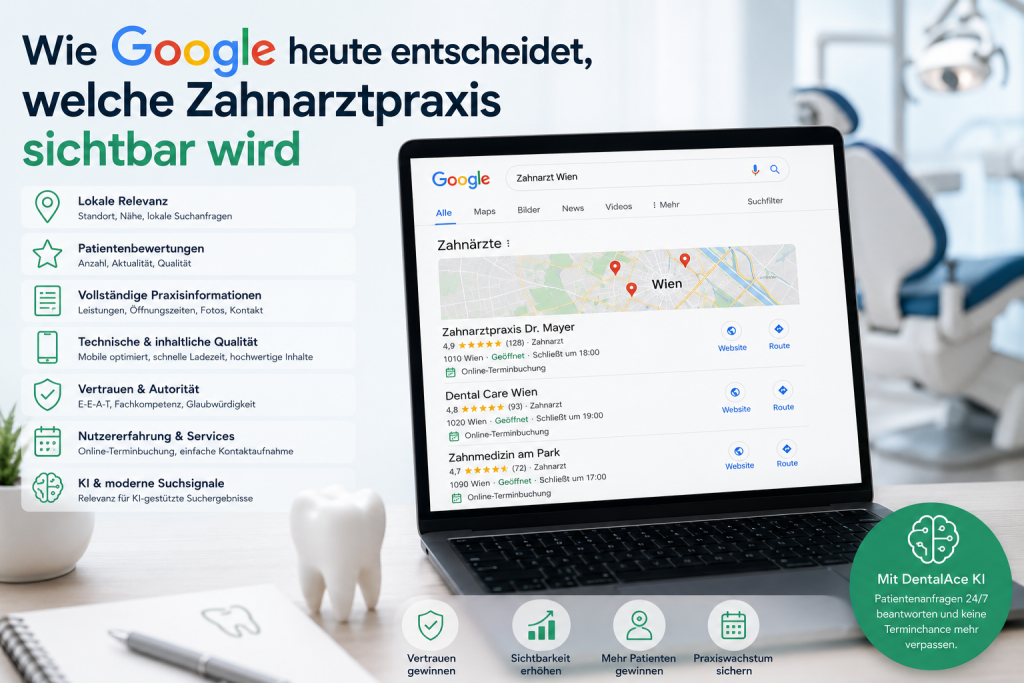
Google für die Zahnarztpraxis
Für die meisten Patienten beginnt die Suche nach einer Zahnarztpraxis heute nicht mehr mit einer Empfehlung aus dem Freundeskreis, sondern bei Google.

Ob „Zahnarzt Wien“, „Implantate Wien“, „Kinderzahnarzt“ oder „Mundhygiene in meiner Nähe“ – innerhalb weniger Sekunden entscheidet sich, welche Praxen überhaupt wahrgenommen werden und welche kaum Beachtung finden.

Weiterlesen

Neue Marktanalyse 2026: Warum viele Zahnarztpraxen jedes Jahr Hunderte Patienten ersetzen müssen

Hinzugefügt am 14.07.2026
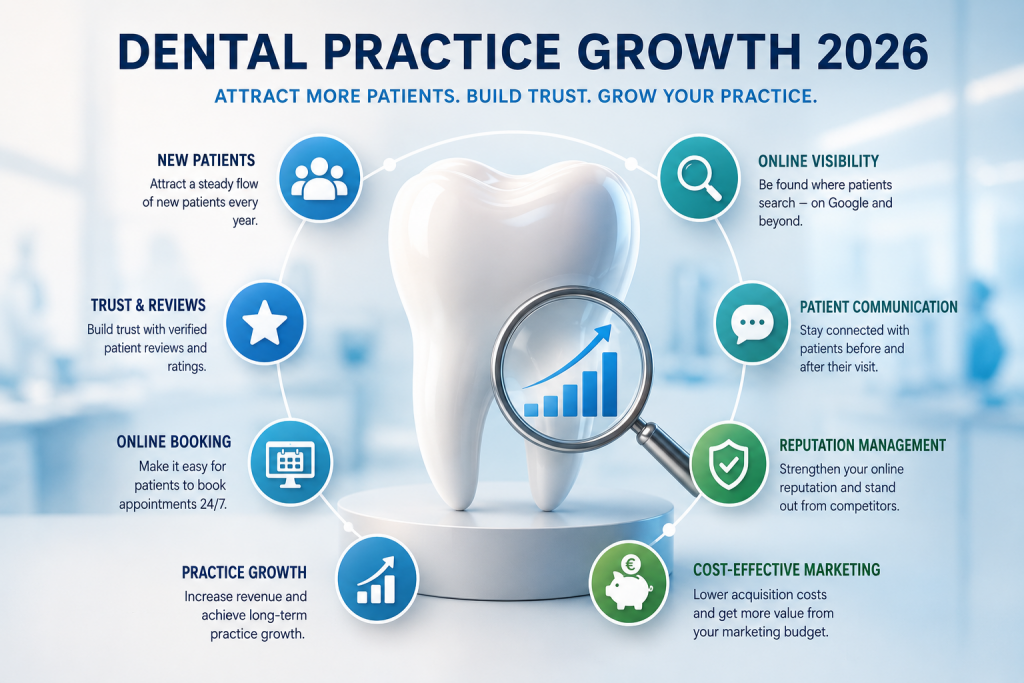
Zahn, Zahnarztpraxis, Zahnarztmarketing
Der wirtschaftliche Erfolg einer Zahnarztpraxis hängt längst nicht mehr ausschließlich von der Qualität der Behandlung ab. Mindestens ebenso wichtig ist eine kontinuierliche und planbare Gewinnung neuer Patienten.

Während viele Praxisinhaber ihre laufenden Kosten genau kennen, wird ein entscheidender Faktor häufig unterschätzt: der natürliche Verlust bestehender Patienten. Wird dieser nicht regelmäßig ausgeglichen, können die Patientenzahl, die Praxisauslastung und langfristig auch der Umsatz zurückgehen.

In diesem DentalAce Market Intelligence Report zeigen wir, wie viele aktive Patienten eine Zahnarztpraxis benötigt, wie hoch der jährliche Patientenverlust ausfallen kann, welche Kosten bei der Patientenakquise entstehen und welche Maßnahmen eine nachhaltige Neupatientengewinnung unterstützen.

Weiterlesen
Seite
1
2
3
4
5
6
7
8
9
10
Hast du Fragen?
Sende uns eine Nachricht