

No Shows in Dental Practices: Causes, Statistics & Solutions to Reduce Missed Appointments (2026)
Missed appointments are among the biggest hidden sources of lost revenue and wasted time in dental practices. At the same time, many practice owners ask themselves: Why do patients fail to attend dental appointments — and how can “no shows” be reduced?
The good news: Many last-minute cancellations and missed appointments can be significantly reduced with the right processes and digital patient communication.
As already highlighted in previous market intelligence analyses, DentalAce supports dental practices in Vienna by helping reduce appointment gaps, minimize cancellations, and improve overall practice utilization.
In this article, we explore the most common reasons for last-minute appointment cancellations — and which measures dental practices can implement to sustainably reduce missed appointments.
What Is the No-Show Rate in Dental Practices?
One of the most frequently asked questions is: How many patients fail to attend their dental appointments?
Although there is limited publicly available data specifically for Vienna, current developments from 2024/2025 paint a clear picture:
- Around 10% complete “no shows”
(the patient does not attend and does not cancel in time) - An additional 10% of last-minute cancellations
(within 24 hours before the appointment)
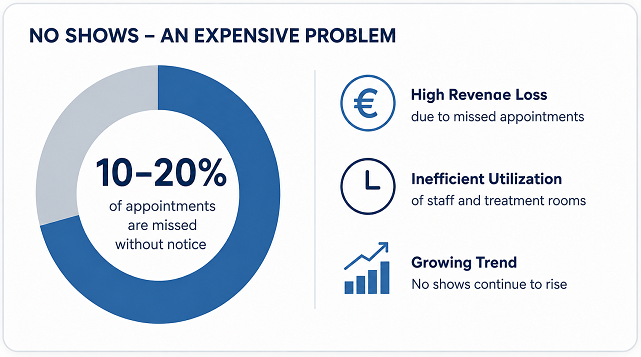
As a result, the combined missed appointment rate in many dental practices ranges between 10% and 20% of all appointments.
For practices handling approximately 1,000 appointments per month, this can mean 100 to 200 missed appointments — with direct consequences for revenue, planning reliability, and operational efficiency.
As a result, many dentists ask: How can dental practices reduce no shows?
Even small improvements — such as automated reminders or digital appointment management — can significantly lower missed appointment rates.
The Most Common Reasons for Missed Appointments — and What Actually Helps
1. The Appointment Was Forgotten
The most common reason is simple: Many patients forget their appointment, especially when it was booked weeks or even months in advance.
Do automatic appointment reminders really help?
Yes. Experience shows that reminders via SMS, email, or phone significantly increase the likelihood that patients either attend their appointment or cancel in time.
Practice Tip:
Automatic reminders sent 24–48 hours before the appointment have proven particularly effective.
DentalAce Solution:
For appointments booked through DentalAce, automatic reminders are sent 24 and 12 hours before the appointment to significantly reduce missed appointments.
2. Professional or Personal Commitments
Unexpected changes in work schedules or family responsibilities often lead to last-minute appointment changes.
Many practices ask: Why do patients cancel dental appointments at short notice?
The answer is often simple: work obligations, childcare, or unexpected personal commitments take priority.
Practice Tip:
Easy online rescheduling increases the likelihood that patients cancel in time instead of simply not showing up.
DentalAce Solution:
Patients can reschedule appointments online in just a few steps — quickly, conveniently, and with less administrative burden for the practice.
3. Fear of the Dentist
Especially before more extensive treatments, some patients develop anxiety or nervousness shortly before their appointment.
Why do patients miss dental appointments despite booking them?
A frequently underestimated factor is dental anxiety.
Practice Tip:
Empathetic communication, transparent treatment explanations, and information about minimally painful procedures help build patient trust.
DentalAce Solution:
Educational articles and patient guides help reduce anxiety even before the appointment takes place.
4. Illness or Health Issues
Colds, fever, or sudden health concerns regularly result in appointment cancellations.
How can practices avoid short-term appointment gaps?
An active waiting list helps fill newly available appointment slots quickly.
Practice Tip:
Patient waiting lists or digital waitlist systems significantly reduce downtime.
DentalAce Solution:
Through the patient portal, active patient inquiries can be reviewed and available appointment slots can be filled more efficiently.
5. Poor Previous Experiences With Waiting Times
Patients remember previous experiences. Those who repeatedly had to wait too long may be less committed to future appointments.
Do waiting times influence no-show rates?
Yes. Long waiting times often reduce patient commitment to future appointments.
Practice Tip:
Efficient appointment scheduling and transparent communication help strengthen patient loyalty over time.
DentalAce Solution:
Digital appointment management and automated communication processes help practices improve operational efficiency.
6. Financial Uncertainty
Particularly for more extensive treatments, patients often have concerns about costs and out-of-pocket expenses.
Do patients cancel dental appointments because of costs?
In many cases, yes — especially when there is uncertainty regarding pricing or additional treatment expenses.
Practice Tip:
Transparent cost communication at an early stage builds trust and reduces uncertainty.
DentalAce Solution:
With the confidential price-check feature, patients can better estimate treatment costs before their appointment.
FAQ: Frequently Asked Questions About No Shows in Dental Practices
What is the average no-show rate in dental practices?
The average no-show rate often ranges between 10% and 20%, depending on the practice structure, patient demographics, and appointment management processes.
Why do patients miss dental appointments?
The most common reasons include forgotten appointments, work or family obligations, dental anxiety, illness, poor past experiences with waiting times, and uncertainty regarding treatment costs.
How can dental practices reduce no shows?
Proven measures include automated appointment reminders, online appointment rescheduling, better patient communication, waiting lists, and transparent pricing information.
Do automatic appointment reminders really help?
Yes. SMS or email reminders 24–48 hours before the appointment can significantly increase the likelihood that patients attend or cancel in time.
How much revenue do dental practices lose due to no shows?
Even 100–200 missed appointments per month can have substantial financial consequences and lead to inefficient downtime.
Conclusion: How Can Dental Practices Reduce No Shows?
Not every missed appointment can be prevented. However, the causes are often predictable — and can be significantly reduced through modern processes.
Automatic reminders, digital appointment booking, transparent communication, and better patient education are among today’s most effective ways to reduce no shows.
Digital solutions help many dental practices improve utilization, close appointment gaps, and strengthen patient retention in a sustainable way.


