
Dentist searches after hours: why online booking and an AI assistant work best together
Patients do not search for a dental practice only during opening hours. The need to make an appointment often arises in the evening, at the weekend or precisely when the practice telephone is no longer staffed.
A clearly visible online booking option allows patients to choose an available appointment outside regular opening hours. However, not every patient can or wants to book without asking a question first.
Some patients do not know which appointment type matches their concern. Others want to ask about insurance, treatments, costs or whether the practice is accepting new patients. Toothache, language barriers or a lack of suitable appointments can also create a need for personal guidance.
Digital accessibility therefore does not end with a booking button. Combining online appointment booking with intelligent telephone support creates a continuous contact pathway: for patients who want to book immediately and for those who first need to ask a question or explain their concern.
Patients search when it fits into their daily lives
The traditional process is simple: a patient wants an appointment, calls during opening hours and speaks to a member of the practice team.
In everyday life, however, this does not always work so smoothly. Patients may be working, caring for children or unable to make a longer telephone call during their own working hours. Others notice discomfort in the evening or decide at the weekend that a check-up or professional dental cleaning is overdue.
They may therefore begin searching for a dentist exactly when the practice is closed. At that moment, they often want immediate answers:
- Is the practice accepting new patients?
- Does it treat public-insurance, elective or private patients?
- Does the practice offer the required treatment?
- Does anyone at the practice speak English or another language?
- Are short-notice appointments available?
- Which appointment type should be selected?
- Can an existing appointment be rescheduled or cancelled?
- What should the patient do in the event of acute toothache?
If patients cannot find enough information or a suitable way to make contact, they may postpone their decision or continue searching for another practice.
What online appointment booking already does very well
An online calendar allows patients to view available appointments and make a booking independently of the practice's opening hours.
This offers clear advantages:
- Appointments can be selected around the clock.
- Patients do not have to wait on the telephone.
- The practice team spends less time arranging routine appointments.
- Short-notice availability can be made visible immediately.
- Appointment confirmations and reminders can be automated.
- Patients can book conveniently by smartphone, tablet or computer.
Through DentalAce, patients can select an appointment directly with participating dental practices or be redirected to the practice's connected online calendar. For patients who already know which treatment or appointment type they need, online booking is often the quickest route to an appointment.
Why an online calendar cannot solve every situation
A booking calendar often assumes that the patient can categorise the concern correctly. That is not always possible.
A patient with toothache may not know whether to select a check-up, an urgent appointment or a first examination. Another patient may want to clarify insurance coverage before booking. Some patients cannot find a suitable appointment and want to know whether an alternative is available.
Language barriers, dental anxiety or limited experience with digital booking systems can also make independent booking more difficult. A gap in accessibility can therefore remain even when an online calendar is available.
Online booking handles the appointment – the AI assistant handles the conversation
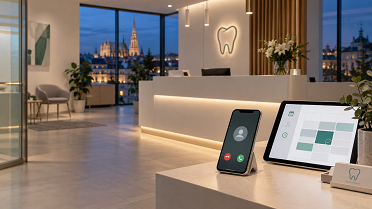
This is where the DentalAce AI assistant Lisa can complement online appointment booking. While the calendar makes appointments bookable around the clock, Lisa helps the practice remain available by telephone outside regular opening hours.
Depending on the individual setup, the AI assistant can:
- answer incoming calls around the clock,
- respond to frequently asked organisational questions,
- provide information about opening hours and treatments,
- share approved information about public-insurance and private services,
- distinguish between new and existing patients,
- record the reason for the call in a structured way,
- help patients select the appropriate appointment category,
- record appointment requests,
- book, reschedule or cancel appointments depending on the calendar integration,
- document information for the practice team and
- conduct conversations in up to six languages.
The assistant's name, voice, tone and conversation style can be adapted to the individual dental practice.
A direct connection to the practice's existing online calendar is possible if the calendar provider supplies the required technical interface.
Lisa does not replace the dentist or a clinical examination and does not provide medical diagnoses. Her role is to improve organisational accessibility, provide information approved by the practice and guide each enquiry towards the appropriate next step.
Online booking and an AI assistant meet different patient needs
Patients prefer different ways of making contact. Some want to select an appointment themselves in just a few clicks. Others prefer to speak, ask a question or make sure they are choosing the correct appointment type.
A modern dental practice should therefore not have to choose between online booking and telephone accessibility.
| Patient situation | Online booking | AI assistant |
|---|---|---|
| Select an available standard appointment | Very suitable | Possible |
| Arrange an appointment after hours | Very suitable | Depends on calendar integration |
| Ask a question before booking | Limited | Very suitable |
| Choose the appropriate appointment type | Patient decides independently | Guidance according to practice rules |
| Ask about insurance and services | Through displayed information | Direct answer using approved practice information |
| Communicate in several languages | Depends on the interface | Up to six languages |
| Change an existing appointment | Depends on the calendar | Possible depending on integration |
| No suitable appointment is visible | Risk of abandonment | Can record the appointment request |
| Patient prefers telephone contact | Not suitable | Very suitable |
The online calendar makes appointments bookable around the clock. Lisa makes the practice reachable around the clock.
What happens if no suitable appointment is available?
A missing or unsuitable appointment in the calendar does not necessarily mean that the patient has been lost.
An AI assistant can record the requested appointment, preferred times and contact details and pass the information to the practice team in a structured format. Depending on the technical connection and configuration, alternative appointments can also be offered or the practice's waiting-list process can be supported.
This can turn a potential abandonment into a qualified enquiry that the practice can follow up efficiently.
Multilingual accessibility for international patients
In an international city such as Vienna, many patients look for a dental practice where they can explain their concern in a familiar language.
A multilingual practice profile helps during the selection process. Questions can nevertheless arise before the appointment, particularly when patients have symptoms, require a more complex treatment or are uncertain about the correct appointment type.
Depending on the selected package and individual setup, Lisa can communicate in up to six languages. The practice determines which languages are available and which information the AI assistant is permitted to provide. Multilingual service can therefore extend beyond the website to the patient's first telephone contact.
Reducing the workload of the practice team
An AI assistant is not relevant only outside opening hours. Calls can also go unanswered during the working day when team members are caring for patients, preparing treatments or completing administrative tasks.
Recurring enquiries often concern the same subjects:
- opening hours,
- directions,
- insurance arrangements,
- available treatments,
- acceptance of new patients,
- appointment bookings,
- rescheduling and
- cancellations.
If some of these organisational conversations are handled automatically, the practice team does not have to switch constantly between patient care and the telephone. Enquiries requiring a personal decision can be recorded and handled by the appropriate team member.
Digital accessibility does not end with a booking button
A clearly visible booking button and a functioning online calendar are essential parts of a modern dental practice. They primarily help patients who are already ready to book independently.
The remaining gap often appears one step earlier: the patient has a question, is unsure about the appointment type, cannot find a suitable time, needs language support or wants to explain the concern first.
An AI assistant can close this gap and guide patients to the next appropriate step according to the processes defined by the practice. Together, the systems create a continuous contact pathway:
- The patient finds the dental practice.
- The patient reviews its treatments, ratings and appointment options.
- The patient books independently or makes contact by telephone.
- The enquiry can be recorded even outside opening hours.
- The practice receives structured information and can respond efficiently.
Conclusion
Patients do not automatically organise their search for a dentist around a practice's opening hours. They want to access information, ask questions and arrange appointments when it fits into their own schedules.
Online booking is ideal for patients who want to select an appointment immediately. The AI assistant complements this route for people who have a question, want to explain their concern or need support with the booking process.
Together, they turn simple online booking into more comprehensive digital accessibility for the dental practice.
Frequently asked questions
Why is online appointment booking not always enough?
An online calendar is particularly suitable for patients who already know which appointment type they need. Questions, urgent concerns, language barriers or a lack of suitable appointments may require additional support. An AI assistant can record the concern and guide the patient to the next step according to the practice's rules.
Does the AI assistant replace the online calendar?
No. The two systems serve different purposes. The calendar enables patients to select an available appointment independently. The AI assistant answers approved organisational questions, takes calls and supports patients who cannot or do not want to book directly through the calendar.
Can Lisa book appointments directly in the practice calendar?
A direct calendar connection is possible if the calendar provider offers the required technical interface. The type and scope of the integration are assessed for each practice.
Which questions can Lisa answer?
Lisa is configured using information approved by the practice. This can include opening hours, treatments, insurance arrangements, directions, appointment types and organisational procedures. The practice determines which information may be provided.
Which languages can Lisa speak?
Depending on the selected package and individual setup, the DentalAce AI assistant can communicate in up to six languages.
Can Lisa provide medical diagnoses?
No. Lisa does not replace a dental examination and does not provide medical diagnoses. She supports organisational enquiries and appointment booking. In an acute medical emergency, patients must contact the appropriate emergency service.
Can the voice and conversation style be customised?
Yes. The name, voice, tone, conversation style and other characteristics can be adapted to the desired presentation of the dental practice.
How can a dental practice get to know Lisa?
Dental practices can request a no-obligation demonstration. This provides an opportunity to discuss suitable languages, conversation flows, practice information and calendar connections.


